Showing posts with label Fruit and Vegetables. Show all posts

Monday, November 1, 2010

Black Bean Paste (춘장=ChunJang)


The black bean paste, called chunjang (춘장) is made from roasted soybeans. When it is unheated, it is called chunjang (literally “spring paste”), while the heated sauce (containing vegetables and meat or seafood) is called jajang (literally “fried sauce”). Onion dipped in the sauce also taste good. Koreans use this paste for balck bean noodles. (JaJangMyun=자장면)

Read more from Wikipedia…


  • Use:
    Sauce for black bean paste noodles (JajangMyun)
  • Storage:
    Keep in the refrigerator.
  • Types:
    Used Korean brand for this recipe.

Pear Juice (배 쥬스=Bae Juice)


In Korea, we use some fruits for cooking such as the Asian pear, apple, kiwi, and so on. Pears are especially good for marinating meat such as BulGoGi, since it gives a naturally sweet flavor, and makes the meat tender. When you can’t get an Asian pear, use a can of pear juice for your cooking. We drink this pear juice in Korea, but it can be used for cooking also. :D

Read more from Wikipedia…

  • Use:
    To drink
    To marinate meat
  • Storage:
    Cabinet or refrigerator
  • Types:
    Korean Brand names : “LOTTE” “HaeTae” “Assi”
  • Short Korean lesson:
    Bae (배)=Pear
    Juice (쥬스)=Juice

Spinach (시금치=SiGeumChi)


Spinach is known as a rich source of iron and calcium. Korean people use spinach for side dishes, soup, or as an ingredient in a main dish.

Read more from Wikipedia…


  • Use:
    Side dish, Soup, Ingredient of main dish
  • Storage:
    Keep in the refrigerator.
  • Short Korean lesson:
    SiGeumChi (시금치)=Spinach

Hot Pepper Powder (고춧 가루=GoChut GaRu)


To make GoChut GaRu (고춧가루), remove the stems of red hot peppers and open them to get rid of the seeds inside. Wipe them dry and then grind them to make powder. Depending on the purpose, the coarseness of the crushed flakes is different. You can use real fine hot pepper powder for a spice, or red pepper paste. Medium-fine powder can be used for napa kimchi or radish kimchi. Course powder is used for summer kimchi, 열무김치. Make sure the powder is well sealed to lock in the nutrients. Two big nutrients of hot peppers are vitamins A and B.

  • Use:
    Kimchi, Seasoning
  • Storage:
    Keep in the cabinet.
    For long-term storage, keep it in the freezer.
  • Types:
    For Kimchi: Course
    For Red Pepper Paste: Medium-Fine
    For other Cooking: Fine
  • Short Korean lesson:
    GOhu (고추)=Hot Pepper or Chilly Pepper
    Garu (가루)=Powder

Korean Radish (조선무 = ChoSunMu)


In Korea, the radish (Daikon=Japanese name) is called ChoSunMu (조선무), it is often pickled, and used in a variety of kimchi called kkakdugi (깍두기). One of the most popular varieties of pickled daikon, called danmuji (단무지) in Korean, is usually bright yellow in color and is sometimes used in sushi or kimbap (김밥). Daikon is very low in food energy. A 3 ounce (85 g) serving contains only 18 Calories (75 kJ) and provides 34 percent of the RDA for vitamin C. Daikon also contains the active enzyme myrosinase that aids digestion, particularly of starchy foods.

Read more from Wikipedia…


  • Use:
    Radish Kimchi, Side dish, Ingredient for Soup, Stew, or Main dish
  • Storage:
    Keep in the refrigerator.
  • Short Korean lesson:
    ChoSun (조선)=Joseon Dynasty
    Mu (무)=Radish

Garlic Stems (마늘쫑=MaNeul Jjong)


Immature garlic stems are tender and edible. They are also known as garlic spears or garlic tops. They have a milder taste than cloves. In Korea, we make some side-dishes with garlic stems. You can fry or pickle them with a spicy sauce or plain pickling spices.

Read more from Wikipedia…


  • Use:
    Side dish
  • Storage:
    Keep in a cool place.
  • Short Korean lesson:
    MaNeul (마늘)=Garlic
    Jjong (쫑)=Stems (Dialect)

Yellow Pickled Radish (단무지=DanMuJi)


Company: Pulmuone/ Product Name: Gardenia Seeds Half-cut Pickled Radish


No Preservative, No MSG, No Artificial Coloring, No Saccharin, No Glacial Acetic Acid

Recently, I learned that some of the artificial ingredients in pickled radishes are not good for health. Some examples of those ingredients are: food coloring, preservatives, MSG, and saccharin. Should I give up eating this delicious food for health? I stopped buying it for a while; however, whenever I was hungry for kimbap, I wished there was a healthy pickled radish. One day, I found this Gardenia Seeds pickled radish from a Korean grocery store. It did not have the unhealthy ingredients that I was afraid to eat. So, I was excited to try it. The taste is not as good as the normal pickled radish, but it is good enough to use, especially considering how much healthier it is. The more I eat it, the more I become accustomed to it and like it. If you can find it in a Korean grocery store, try it someday.


Takuan, also known as takuwan, is a popular traditional Japanese pickle. Takuan is also popular in South Korea, and is called danmuji (단무지). It is made from daikon radish.

Read more from Wikipedia…


  • Use:
    filling for KimBap, an accompaniment to Korean dishes, typically JaJangMyeon, or a side-dish.
  • Storage:
    Keep in the refrigerator.
  • Types:
    There are 2 colors of pickled radish; white and yellow.
    There are 4 kinds of shapes for pickled radish.
    1. Already cut for kimbap size.
    2.Whole radish
    3. Half cut radish (like the picture)
    4. sliced thinly ( for jajangmyeon or side-dish)
  • Short Korean lesson:
    Dan(단)= Sweet
    Mu(무)= Radish
    Ji(지)= pickled

Shiitake Mushrooms (표고 버섯=PyoGo BeoSeot)


The shiitake (Lentinula edodes) is an edible mushroom native to East Asia, which is cultivated and consumed in many Asian countries, as well as being dried and exported to countries around the world. It is a feature of many Asian cuisines including Chinese, Japanese, Korean and Thai. In Korean cuisine, they are commonly used in dishes such as bulgogi (marinated grilled beef), jjigae (stews), and namul (sauteed vegetable dishes).

Read more from Wikipedia…


  • Use:
    Ingredient for soup, stew, main dish, or side dish
  • Storage:
    Keep in the cabinet.
  • Types:
    Fresh, Dried, or Frozen Shiitake Mushrooms
  • Short Korean lesson:
    PyoGo (표고)=Shiitake
    BeoSeot (버섯)=Mushroom

Tofu (두부=DuBu)


Tofu is made by coagulating soy milk and pressing the resulting curds. Although pre-made soy milk may be used, most tofu producers begin by making their own soy milk, which is produced by soaking, grinding, boiling and straining dried (or, less commonly, fresh) soybeans.

Read more from Wikipedia…


  • Use:
    Soup, Stew, Side dish, Ingredient for dumplings
  • Storage:
    Keep in the refrigerator.
  • Types:
    Soft: for salad, soup (SunDuBu)
    Normal: Soup
    Firm: Frying
  • Short Korean lesson:
    Dubu (두부)=Tofu

Red Bean Paste (팥 앙금=Pat AngGeum)


Red bean paste or Azuki bean paste is a sweet, dark red bean paste originating from China. It is used in Chinese cuisine, Japanese confectionery, and Korean cuisine. It is prepared by boiling and mashing azuki beans and then sweetening the paste with sugar or honey. The husk of the beans may be removed by sieving before sweetening, which leads to a smoother and more homogeneous paste.

Red bean paste is used in various Korean snack foods and desserts; including: Baram Dduk, BungEoPpang (붕어빵), HoTteok (호떡), PatBingSu (팥빙수), PatDanJa (팥단자), PatJuk (팥죽), PatTteok (팥떡)

Read more from Wikipedia…


  • Use:
    Dessert (Filling, For rice cakes), Porridge
  • Storage:
    Once it’s opened, keep it in the refrigerator.
  • Types:
    Smooth paste for: filling
    Paste with red bean chunks for: PatGingSu, Porridge
  • Short Korean lesson:
    Pat (팥)=Red Bean
    AngGeum (앙금)=Paste

Dried Bellflower Root (도라지=DoRaJi)


The root of this species (radix platycodi) is used extensively in as an anti-inflammatory in the treatment of coughs and colds. In Korea the plant is known as DoRaJi (도라지) and its root, either dried or fresh, is a popular ingredient in salads and traditional cuisine.

This has bitter taste, so you have to soak in water several hours (fresh one) or at least overnight (dried one) before you use them for cooking.

Read more from Wikipedia…


  • Use:
    For Cold, Sidedishes, Soup, Salad, BiBimBap
  • Storage:
    Dried Bellflower roots: Keep in the cabinet. Long term storage: Keep in the freezer
    Fresh Bellflower roots: Keep in the refrigerator
  • Types:
    Dried, Fresh
  • Short Korean lesson:
    DoRaJi (도라지)=Bellflower Root

Mung Bean Sprouts (숙주=SukJu)


In Korea, slightly cooked mung bean sprouts, called SukJu NaMul (숙주나물), are often served as a side dish. They are placed into boiling water for less than a minute, immediately cooled down in cold water, and mixed with sesame oil, garlic, salt, and often other ingredients.

Read more from Wikipedia…


  • Use:
    Side-dish, Ingredient for soup or main dish
  • Storage:
    Keep in the refrigerator.
  • End so on:
    They go bad very quickly, so once you buy them, use them quickly.
    They absorb a lot of water when boiled, so depending on the dish you are making, you may need to squeeze the absorbed water out.
  • Short Korean lesson:
    SukJu (숙주)=Mung Bean Sprout

Dried Fernbrake (말린 고사리=MalLin GoSaRi)


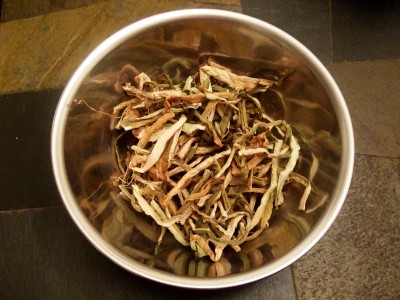
In East Asia, Pteridium aquilinum (fernbrake or bracken fiddleheads) is eaten as a vegetable. In Korea, a typical banchan (small side dish) is GoSaRi-NaMul (고사리나물) that consists of prepared fernbrake that has been sauteed. It is a component of the popular dish BiBimBap.

Read more from Wikipedia…


  • Use:
    Side-dish, Ingredient for soup, For BiBimBap
  • Storage:
    Dried one: Keep in the cabinet.
    Soft one: Keep in the refrigerator.
  • How to use:
    If you get dried Fernbrake, soak it in water at least one night before you use it for cooking. This will get rid of the small bitter flavor, and become soft to eat. Wash it well, and boil it for some time before using it as an ingredient. You can also buy fernbrake that is already soaked in water and read to cook. Just wash it and use it for cooking.
  • Short Korean lesson:
    MalLin (말린) = Dried
    GoSaRi (고사리) = Fernbrake

Dried Taro Stem (말린 토란대=MalLin ToRanDae)


In South Korea, Taro is called ToRan (토란) meaning “egg from earth”, and the corm is stewed and the leaf stem is stir-fried. Taro roots can be used for medicinal purposes, particularly for curing insect bites. I tried to find this in Korean stores here (USA) but I couldn’t. My mom sent this to me from Korea. I tried to think of what kind of vegetables you can substitute for this, if you can’t find it. When I consider the texture, I recommend oyster mushroom or Enokitake mushroom. Those substitutes are especially good when making the Korean soup YukGaeJang.

Read more from Wikipedia…


  • Use:
    Side-dish, Ingredient for soup (YukGaeJang)
  • Storage:
    Keep in the cabinet.
  • Types:
    If you get dried Taro Stems, soak them in water at least one night before you use them for cooking. This will get rid of the small bitter flavor, and they will become soft to eat. Wash them well, and boil them for some time before using them as an ingredient.
  • Short Korean lesson:
    MalLin (말린) = Dried
    ToRanDae (토란대) = Taro Stem

Napa Cabbage (배추=BaeChu)


In Korea, napa cabbage (BaeChu) is used in making the most common type of kimchi. It is the main ingredient of baechu kimchi, but is also eaten raw as a wrap for pork or oysters, dipped in gochujang. The outer, tougher leaves are called ugeoji, and used in soups.

Read more from Wikipedia…


  • Use:
    Kimchi, Side-dish, Ingredient for soup or main dish
  • Storage:
    Keep in the refrigerator.
  • Short Korean lesson:
    BaeChu (배추) = Napa Cabbage

Asian Pear (배=Bae)


In Korea, we use some fruits for cooking such as the Asian pear, apple, kiwi, and so on. Pears are especially good for marinating meat such as BulGoGi, since it gives a naturally sweet flavor, and makes the meat tender.

Read more from Wikipedia…


  • Use:
    For dessert
    To marinate meat
  • Storage:
    Refrigerator
  • Short Korean lesson:
    Bae (배)=Pear

Seasoned Soybean Curd (유부=YuBu)


This is ready-made yubu chobap packed with seasoned soybean curd and sauce. It was my first time to try this brand (Assi,) and it was good enough to use again.


  1. Seasoned Soybean Curd
  2. Seasoning for the Rice (It has dried vegetables and black sesame seeds)
  3. Sauce for the Rice (Sugar and vinegar flavor)

Soybean curd is basically fried, dried tofu.

Read more from Wikipedia…


  • Use:
    For ChoBap
  • Storage:
    Keep in the refrigerator.
  • Short Korean lesson:
    DuBu (두부) = Tofu

Red Pepper Paste (고추장=GoChuJang)


GoChuJang is one of the most important Korean ingredients. If you are into Korean food, you will need this for your Korean cooking. There are many different brands on the market, but “SoonChang (순창) Gochujang” is known as a very good brand in Korea.

Read more from Wikipedia…


  • Use:
    Side Dishes, Main Dishes, Soups, Dipping Sauces
  • Storage:
    Once the container is opened, keep it in the refrigerator.
  • Short Korean lesson:
    GoChuJang (고추장) = Red Pepper Paste

Pickled Cucumber (OiJi=오이지)


  • Use: Side-dish
  • Storage:
    Keep in the refrigerator.
  • Short Korean lesson:
    Mool (물) = Water

Baby Potatoes (알 감자= Al GamJa)


There are different kinds of potatoes in the world depending on the color, size, texture, and the flavor. These bite size baby potatoes that I post today are used for side-dishes in Korean cuisine. We call them AlGamJa. Al means an egg or an egg shaped thing. The potato shape matches good with the name. Since the skin is very thin and soft, you can just eat the potatoes with the skin.

Read more from Wikipedia…

  • Use: Side-dish
  • Storage:
    Keep in the storage place without light.
  • Short Korean lesson:
    Al (알) = Egg shape